Table of Contents (Jump to section)
Over the past three years, enterprise software engineering has undergone a profound architectural pivot. The initial wave of generative AI integrations—characterized by simplistic prompt engineering, hard-coded LangChain wrappers, and monolithic OpenAI API calls—has collided violently with production realities. In production environments handling enterprise financial workflows, distributed inventory mutations, and mission-critical telemetry, probabilistic Large Language Models (LLMs) cannot be granted unconstrained, raw network access, nor can they be trusted with implicit database execution.
In 2026, high-velocity engineering organizations have moved decisively to Agentic Backend Systems. Unlike passive chatbots that merely return unstructured natural language tokens, autonomous agents are stateful, goal-driven orchestrators capable of decomposing complex goals into sequential execution plans, dynamically discovering and calling remote enterprise tools, evaluating real-world observations, and recovering from runtime errors.
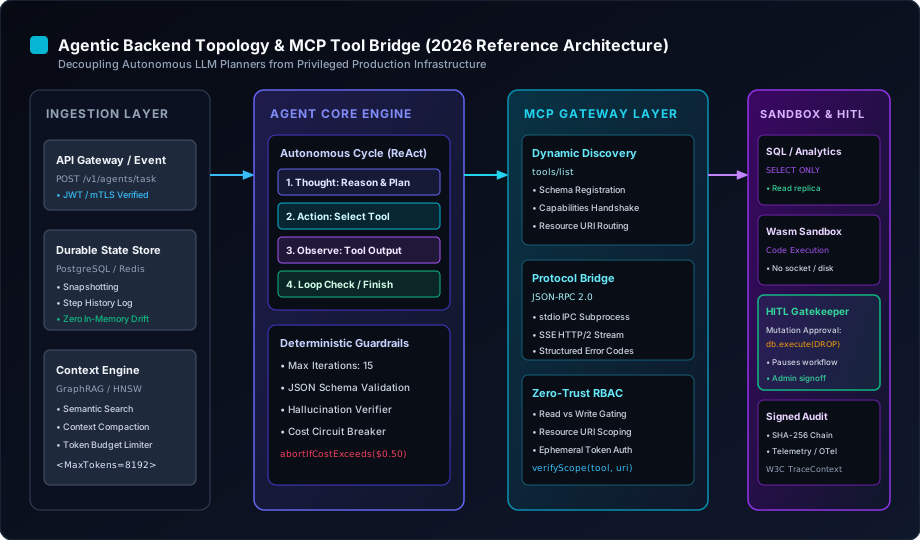
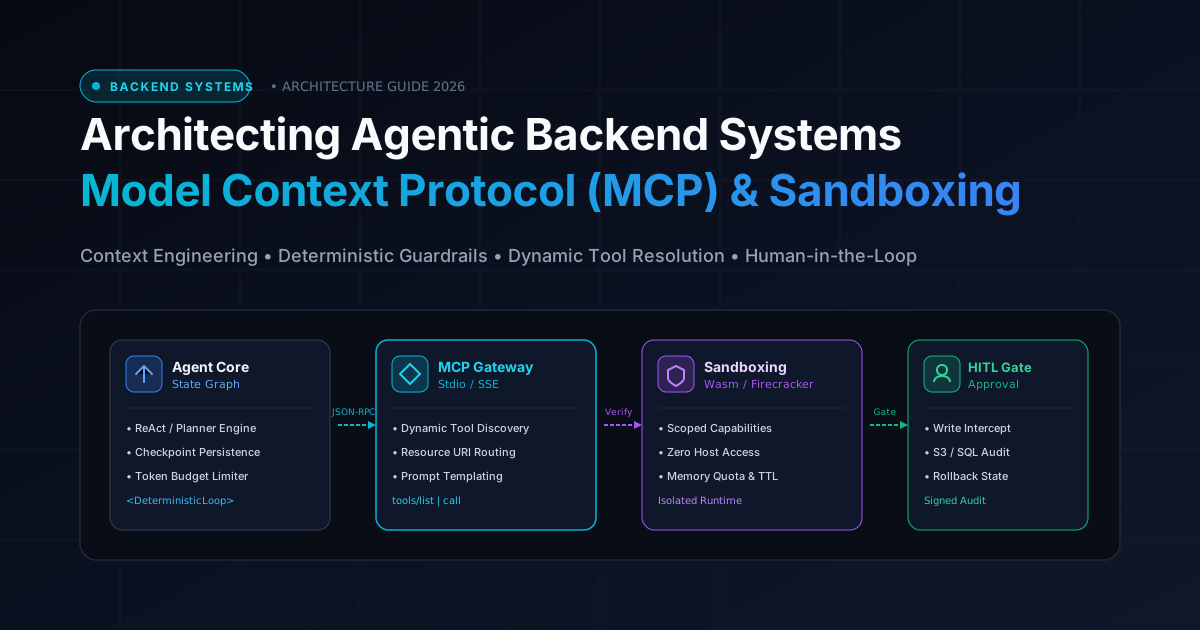
However, running autonomous agents against production infrastructure introduces unprecedented architectural hazards: non-deterministic tool looping, runaway token consumption, prompt injection vulnerabilities, and catastrophic unreviewed state mutations. To solve these fundamental challenges, the industry has standardized on the Model Context Protocol (MCP), rigorous Context Engineering, Micro-VM / WebAssembly sandboxing, and distributed Human-in-the-Loop (HITL) checkpoints. In this engineering deep-dive, we examine the production blueprint for scalable, secure agentic backend systems in modern cloud ecosystems.
---1. The Evolution: From Brittle Prompt Chains to Agentic State Machines
To appreciate the architectural necessity of agentic systems, we must analyze the systematic failure points of early AI integration patterns:
| Architectural Pattern | Execution Flow | Failure Profile at Scale | State & Recovery Strategy |
|---|---|---|---|
| Direct LLM Prompting | Single request-response; prompt template compiled with static variables | Zero multi-step problem solving; unable to gather external data | Stateless; no memory or retry capability |
| Linear Chains (DAGs) | Hardcoded directed acyclic graphs (Step A → Step B → Step C) | Rigid and brittle; unexpected inputs cause catastrophic pipeline stalls | Deterministic fail-fast; unable to self-correct upon tool error |
| Autonomous ReAct Agents | Dynamic Thought → Action → Observation loop driven by LLM planner | Infinite recursion loops, prompt injection exploits, context window blowout | Cyclic state graph with deterministic loop counters and checkpointing |
| Enterprise MCP Orchestrators | Standardized JSON-RPC protocol, sandboxed tool execution, HITL gates | Mitigated via strict capability schemas, token budgets, and audit logging | Durable event-driven state machine with cryptographic audit trail |
Early chain abstractions treated tool calls as hardcoded C# or TypeScript functions directly compiled into the host web process. This tightly coupled the AI runtime with privileged internal services, creating massive attack vectors. If an LLM hallucinated an invalid argument or succumbed to indirect prompt injection from an external webhook, it could trigger unconstrained database deletions or unauthorized network calls.
Modern agent architectures replace linear DAGs with cyclic state graphs governed by state machines. The agent maintains explicit state snapshots, inspects structured intermediate observations, and possesses the autonomy to backtrack, re-prompt, or change its strategy when a tool execution returns an error code.
---2. Model Context Protocol (MCP): The Universal Bridge for Distributed Tools
Before late 2024, every AI vendor and framework implemented proprietary tool-calling formats. OpenAI used JSON function definitions, Anthropic implemented proprietary tool schemas, and local models required complex regex-parsed output formatting. Adding a new internal enterprise tool (such as querying an ERP database or inspecting Kubernetes cluster health) required rewriting adapter code for every individual agent.
The Model Context Protocol (MCP), pioneered by Anthropic and rapidly adopted across the software industry, provides an open, standardized JSON-RPC 2.0 protocol that cleanly decouples AI models from data sources and tools. Under MCP, the architecture is divided into three distinct roles:
- MCP Host (Agent Core): The central orchestrator (e.g., an ASP.NET Core backend or Python service) that manages agent lifecycle, handles conversation context, queries the LLM, and coordinates execution.
- MCP Client: A protocol adapter inside the host that maintains active connections to multiple MCP servers over standard input/output (
stdio) for local processes, or Server-Sent Events (SSE) / HTTP/2 for remote distributed microservices. - MCP Server: A lightweight, isolated service that exposes a well-defined boundary of capabilities to the client:
- Tools: Executable functions that cause side effects or perform calculations (e.g.,
query_sales_db,provision_cloud_runner). - Resources: Read-only data endpoints referenced by URI schemes (e.g.,
postgres://warehouse/orders/schema,git://repo/commit/head). - Prompts: Pre-configured, version-controlled prompt templates optimized for specific domain tasks.
- Tools: Executable functions that cause side effects or perform calculations (e.g.,
The MCP Handshake and Tool Discovery Lifecycle
When an MCP Client initializes a connection to an MCP Server, a dynamic capability negotiation occurs:
// 1. Client sends initialize request
{
  "jsonrpc": "2.0",
  "id": 1,
  "method": "initialize",
  "params": {
    "protocolVersion": "2024-11-05",
    "capabilities": { "roots": { "listChanged": true } },
    "clientInfo": { "name": "MangobazEnterpriseAgent", "version": "2.4.0" }
  }
}

// 2. Server replies with supported capabilities
{
  "jsonrpc": "2.0",
  "id": 1,
  "result": {
    "protocolVersion": "2024-11-05",
    "capabilities": {
      "tools": { "listChanged": false },
      "resources": { "subscribe": false }
    },
    "serverInfo": { "name": "PostgreSqlCatalogServer", "version": "1.2.0" }
  }
}

// 3. Client queries available tools dynamically
{
  "jsonrpc": "2.0",
  "id": 2,
  "method": "tools/list",
  "params": {}
}
Because tool discovery happens dynamically over the protocol wire, backend teams can deploy, update, and patch tool servers independently of the core agent model. If a database schema changes, only the specific database MCP server is deployed—the agent dynamically fetches the updated tool description on its next execution cycle without requiring a full backend recompilation.
---3. Context Engineering: Token Budgets, Compaction, and GraphRAG
A prevalent misconception in naive AI development is that large context windows (128k, 1M, or 2M tokens) eliminate the need for careful memory management. In production backend systems, dumping hundreds of thousands of tokens into an LLM context causes severe degradations:
- The "Lost in the Middle" Phenomenon: Retrieval accuracy drops precipitously as context length expands. Critical instructions and tool constraints placed in the middle of massive context windows are routinely ignored by attention heads.
- Quadratic Latency & Cost Explosion: Time-to-First-Token (TTFT) scales aggressively with input prompt length. A request with 100,000 input tokens can take 8 to 15 seconds simply to initiate token generation, destroying API responsiveness and inflating token costs by 4,000%.
- Context Rot & Hallucination Loops: When an agent loops through 10 iterations, previous failed tool attempts and stack traces pollute the prompt, causing the model to repeat errors.
Context Engineering is the disciplined practice of dynamically assembling, filtering, compacting, and pruning the context window for every agent step.
The Four-Tier Context Architecture
- Tier 1: System Guardrails & Personality (Fixed • ~800 tokens): Immutable system instructions defining behavioral boundaries, safety rules, output schema contracts, and emergency termination keywords.
- Tier 2: Active Working Memory & Goal (Dynamic • ~1,500 tokens): The primary user objective, the current step number, active variables, and the immediate sub-task plan.
- Tier 3: Dynamic Knowledge Retrieval (GraphRAG & Vector Embeddings) (~2,500 tokens): Rather than raw vector search that returns disconnected chunk fragments, GraphRAG maps entities and relationships (e.g., Customer → Order → Product → Warehouse), injecting dense semantic graphs directly into context.
- Tier 4: Compacted Interaction History (~3,000 tokens): Rolling conversational history. When history exceeds the token threshold, an asynchronous background summarizer collapses older turns into structured state deltas:
[Step 1-4 Summary: Queried order #9821, confirmed payment settled, fetched tracking ID 1Z999. Action pending: Carrier API webhook verification.]
4. Tool Sandboxing & Defense-in-Depth Execution
Granting an AI agent the ability to execute code or invoke HTTP webhooks without isolation is an egregious security vulnerability. If an adversary injects malicious instructions into an ingested PDF or database field (indirect prompt injection), the agent could be instructed to dump environment secrets, exfiltrate API tokens, or execute destructive shell commands.
Production agent architectures enforce a multi-layered Defense-in-Depth Sandboxing Model:
| Isolation Layer | Technology | Cold Start Latency | Capabilities & Boundaries |
|---|---|---|---|
| Micro-VM (Virtualization) | AWS Firecracker / Kata Containers | 15ms – 120ms | Full hardware virtualization; dedicated Linux kernel; isolated memory; zero host bleed |
| WebAssembly (Wasm) | Wasmtime / WasmEdge | < 1ms | Strict capability-based security (WASI); memory sandboxed to 64MB; no disk/network access unless explicitly mounted |
| Read-Only Database Proxy | PgBouncer / Read Replicas | 0ms (Pooled) | Enforces read-only user permissions; hard execution timeout (500ms); maximum row limit (50 rows) |
| Network Egress Firewall | eBPF / Cilium Network Policies | Sub-millisecond | Strict domain allow-listing; blocks direct IP connections, internal VPC metadata (169.254.169.254), and private subnets |
Whenever an agent executes dynamic Python data-science code or transforms data, the execution runs inside a transient WebAssembly sandbox with zero network access and a strict 500-millisecond execution deadline. If the code loops infinitely or consumes excessive memory, the runtime host instantly terminates the Wasm instance and feeds a structured timeout error back to the agent.
---5. Distributed Human-in-the-Loop (HITL) Checkpoints
While autonomous read-only operations (analyzing metrics, fetching tickets, summarizing logs) can proceed without human intervention, any state-mutating action (updating financial records, sending emails to external clients, dropping database indexes, deploying production code) must be intercepted by a Human-in-the-Loop (HITL) Gatekeeper.
Naive implementations block the HTTP thread waiting for an admin to click "Approve" in a web dashboard, causing thread pool exhaustion and socket timeouts. Modern systems treat HITL as a durable pause in the agent's state machine:
- Checkpoint Serialization: The agent recognizes that the next tool (
execute_refund_payout) requires high-risk authorization. It serializes its complete state graph (current variables, step history, proposed tool parameters, justification) to a durable store (PostgreSQL / Redis). - Workflow Suspension: The execution terminates cleanly, freeing all compute threads and resources. A unique
ApprovalRequestIdis generated. - Notification Dispatch: An asynchronous event is dispatched to Slack, Microsoft Teams, or the admin portal containing the proposed mutation diff, risk assessment, and two cryptographic approval tokens (
APPROVE/REJECT). - Resume on Event: When the authorized human clicks "Approve", a webhook invokes the backend orchestrator. The state machine rehydrates the serialized checkpoint from the database, executes the authorized tool, and continues its autonomous loop to completion.
6. Production Implementation in C# / .NET 9
Let us implement an enterprise-grade agent orchestrator in C# / .NET 9 utilizing Microsoft Semantic Kernel, structured JSON-RPC communication, and deterministic loop guardrails.
The Orchestrator Core with Step Guardrails
using System.Text.Json;
using System.Text.Json.Serialization;
using Microsoft.Extensions.Logging;

public sealed class AgentOrchestrator
{
    private readonly IMcpClient _mcpClient;
    private readonly ILlmEngine _llm;
    private readonly ILogger<AgentOrchestrator> _logger;
    private const int MaxIterations = 10;
    private const decimal MaxBudgetUsd = 0.50m;

    public AgentOrchestrator(IMcpClient mcpClient, ILlmEngine llm, ILogger<AgentOrchestrator> logger)
    {
        _mcpClient = mcpClient;
        _llm = llm;
        _logger = logger;
    }

    public async Task<AgentExecutionResult> ExecuteTaskAsync(string goal, CancellationToken ct = default)
    {
        var context = new AgentStateContext
        {
            Goal = goal,
            StartedAt = DateTime.UtcNow,
            CumulativeCostUsd = 0m
        };

        // 1. Dynamic Tool Discovery via MCP Protocol
        var availableTools = await _mcpClient.ListToolsAsync(ct);
        _logger.LogInformation("Discovered {Count} dynamic tools from MCP servers.", availableTools.Count);

        for (int step = 1; step <= MaxIterations; step++)
        {
            ct.ThrowIfCancellationRequested();
            context.CurrentIteration = step;

            // 2. Budget Circuit Breaker Check
            if (context.CumulativeCostUsd > MaxBudgetUsd)
            {
                _logger.LogWarning("Budget exceeded ({Cost:C2} > {Max:C2}). Halting execution.",
                    context.CumulativeCostUsd, MaxBudgetUsd);
                return AgentExecutionResult.Halted("Token budget limit reached.", context);
            }

            // 3. Construct Compacted Prompt with Working Memory & Tool Signatures
            var prompt = ContextEngine.BuildPrompt(context, availableTools);

            // 4. Query LLM Planner for Next Action
            var decision = await _llm.GenerateDecisionAsync(prompt, ct);
            context.CumulativeCostUsd += decision.CostUsd;

            _logger.LogInformation("Step {Step}: Thought: {Thought}", step, decision.Thought);

            // 5. Check Termination Condition
            if (decision.IsComplete)
            {
                _logger.LogInformation("Task resolved successfully in {Step} iterations.", step);
                return AgentExecutionResult.Completed(decision.FinalAnswer!, context);
            }

            // 6. Validate and Execute Tool via MCP Bridge
            if (decision.SelectedTool is null)
            {
                context.History.Add(new StepRecord(step, decision.Thought, null, "Error: No tool selected."));
                continue;
            }

            // 7. Human-in-the-Loop Intercept for High-Risk Mutations
            if (decision.SelectedTool.RequiresApproval)
            {
                var approvalId = await SuspendForHumanApprovalAsync(context, decision.SelectedTool, ct);
                return AgentExecutionResult.SuspendedPendingApproval(approvalId, context);
            }

            // 8. Safe Execution inside Sandbox
            var toolResult = await _mcpClient.CallToolAsync(
                decision.SelectedTool.ServerName,
                decision.SelectedTool.ToolName,
                decision.SelectedTool.Arguments,
                ct);

            // 9. Append Observation to State History
            context.History.Add(new StepRecord(step, decision.Thought, decision.SelectedTool, toolResult.RawOutput));
        }

        return AgentExecutionResult.Halted("Maximum iteration limit reached without resolution.", context);
    }

    private Task<string> SuspendForHumanApprovalAsync(AgentStateContext ctx, ToolCallRequest tool, CancellationToken ct)
    {
        var approvalId = Guid.NewGuid().ToString("N");
        // Persist checkpoint to database (PostgreSQL / SQLite)
        _logger.LogWarning("MUTATION INTERCEPT: Pausing workflow for tool '{Tool}'. Approval ID: {Id}",
            tool.ToolName, approvalId);
        return Task.FromResult(approvalId);
    }
}

public sealed record StepRecord(int Step, string Thought, ToolCallRequest? Action, string Observation);7. Observability: Distributed Tracing with OpenTelemetry & Signed Audit Logs
When an agent executes 15 asynchronous steps across 4 distributed MCP microservices, debugging failures with standard text logs is virtually impossible. Production systems require deep observability anchored by OpenTelemetry and the W3C TraceContext standard.
Every individual agent execution run is treated as a top-level OpenTelemetry Trace. Each autonomous loop iteration, LLM generation, and MCP tool call is recorded as a child Span with standardized semantic attributes:
gen_ai.system:claude-3-7-sonnet/gpt-4ogen_ai.usage.prompt_tokens:2140gen_ai.usage.completion_tokens:342mcp.tool.name:execute_sql_querymcp.tool.exit_code:0mcp.tool.duration_ms:42.8
Furthermore, enterprise compliance mandates a tamper-evident audit log. When an agent executes an approved action, the system generates a cryptographically signed audit envelope containing the prompt hash, the model version, the exact MCP tool arguments, the identity of the approving human, and the resulting payload. This envelope is hashed with SHA-256 and appended to an append-only S3 Glacier or SQL ledger, guaranteeing immutable accountability for every autonomous decision.
---8. Architecture Comparison Matrix
| Capability Dimension | Naive LangChain / SDK Scripting | Production Agentic Backend (MCP) |
|---|---|---|
| Tool Decoupling | Hardcoded Python/C# function bindings inside host process | Standardized JSON-RPC 2.0 protocol over stdio / SSE microservices |
| Fault Isolation | Tool exceptions or memory leaks crash host agent | Sandboxed WebAssembly / Firecracker micro-VM runtimes |
| Context Management | Raw chat history appending until token window overflows | Dynamic GraphRAG, token budgets, and rolling state compaction |
| State Mutation Safety | Unchecked autonomous execution; high risk of data destruction | Durable checkpointing and Human-in-the-Loop (HITL) approval gates |
| Observability | Console print statements and raw text log files | Full W3C OpenTelemetry distributed tracing and signed audit ledgers |
| Vendor Portability | Locked to proprietary tool calling schemas (OpenAI / Anthropic) | Universal MCP interface; swap LLM models without altering tool servers |
Frequently Asked Questions (FAQ)
What is the primary advantage of Model Context Protocol (MCP) over REST APIs for agent tools?
While REST APIs require custom client integration code, authentication wrappers, and endpoint documentation for each service, MCP provides a universal, bidirectional protocol (JSON-RPC 2.0). MCP servers expose a standardized tools/list schema and resource addressing system. This allows any compliant agent orchestrator to dynamically discover, validate, and execute tools at runtime without writing bespoke API glue code.
How do you prevent an autonomous agent from entering an infinite execution loop?
Production agent systems enforce three deterministic circuit breakers: (1) a hard iteration ceiling (e.g., maximum 10 to 15 steps per task), (2) a financial token budget limiter (e.g., abort if total prompt/completion cost exceeds $0.50), and (3) a repetitive action detector that hashes previous tool inputs and halts execution if the identical tool call is triggered consecutively with the same parameters.
What is the difference between Prompt Engineering and Context Engineering?
Prompt Engineering focuses on the static wording, tone, and framing of instructions provided to an AI model. Context Engineering is a systems engineering discipline: it encompasses dynamically calculating token budgets, compacting multi-turn conversation histories, resolving dynamic knowledge graphs (GraphRAG), pruning unneeded tool outputs, and maintaining working memory so that the LLM receives the most informative, minimal context possible on every single step.
How is Human-in-the-Loop (HITL) implemented without blocking web server threads?
Never hold a synchronous HTTP request or thread open while waiting for human review. When a high-risk tool is selected, the agent serializes its execution graph to a persistent database (PostgreSQL or Redis) and terminates the active thread. A notification is dispatched with a cryptographic callback token. When the administrator approves or rejects the action via webhook, the worker rehydrates the state machine from the database and resumes execution seamlessly.