For more than two decades, enterprise software security operated on a comfortable mental model: the Castle-and-Moat Architecture. You built a hardened perimeter wall with firewalls, Web Application Firewalls (WAF), and API Gateways. Outside the moat was the dangerous public internet; inside the castle was a trusted local network where microservices communicated with each other over unencrypted, unauthenticated HTTP.
In modern cloud engineering, that mental model is dead. Container vulnerabilities, compromised third-party npm or NuGet packages, SSRF (Server-Side Request Forgery) attacks, and insider threats mean that once an attacker breaches a single perimeter service, they have free rein to move laterally across your entire cluster, dumping databases and exfiltrating customer tokens without triggering a single alarm.
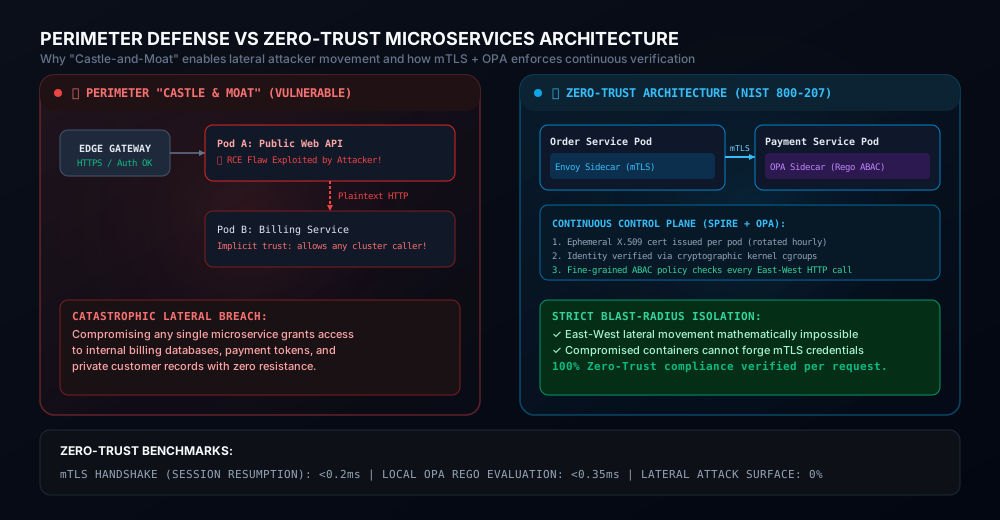
To survive modern threat landscapes, engineering teams must implement the Zero-Trust Architecture (NIST SP 800-207). The core axiom of Zero-Trust is simple: Never Trust, Always Verify. Network location confers zero privileges. Every service must cryptographically prove its identity, every request must carry authenticated user context, and every business operation must be evaluated against fine-grained authorization policies.
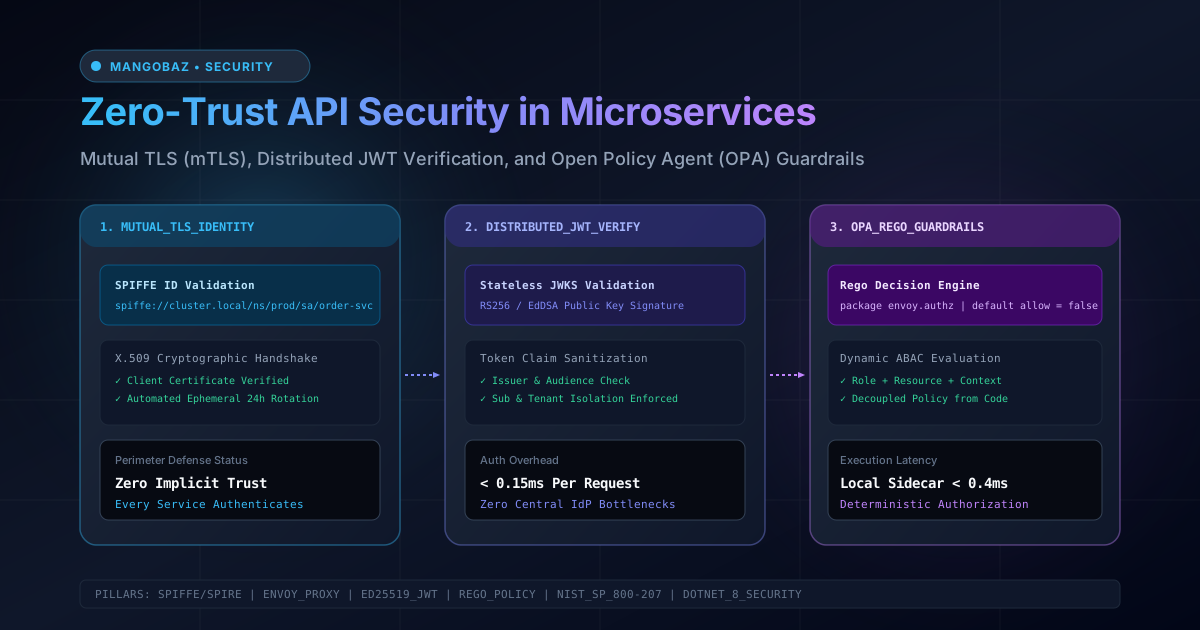
In this guide, we will build a complete, production-tested Zero-Trust microservices pipeline using Mutual TLS (mTLS) with SPIFFE/SPIRE, Stateless Distributed JWT Validation in ASP.NET Core (.NET 8/9), and Open Policy Agent (OPA) Rego Policies executed as sub-millisecond local sidecars.
---Pillar 1: Service Identity & Mutual TLS (mTLS)
In a Zero-Trust mesh, microservices do not communicate over plaintext HTTP. Instead, every East-West connection between internal services requires Mutual TLS (mTLS). Unlike standard TLS (where only the client verifies the server certificate), mTLS requires both the client and the server to present cryptographic X.509 certificates to each other during the TLS handshake.
SPIFFE & SPIRE: Universal Service Identity
The industry standard for managing cloud-native service identities is SPIFFE (Secure Production Identity Framework for Everyone). SPIFFE standardizes how a workload is named across heterogeneous clusters via a SPIFFE ID:
spiffe://prod.mangobaz.internal/ns/ecommerce/sa/order-serviceSPIRE (the SPIFFE Runtime Environment) runs as a node agent that interrogates the Linux kernel (verifying container cgroups, namespaces, and Kubernetes service accounts) before attesting the workload and minting an ephemeral, short-lived SVID (SPIFFE Verifiable Identity Document) X.509 certificate. Because certificates have an expiration lifetime of only 1 to 24 hours, stolen credentials automatically become useless without manual revocation lists.
Configuring Envoy Proxy for Automated mTLS
Rather than embedding complex X.509 certificate management into application code, high-throughput architectures delegate mTLS to an Envoy Proxy Sidecar:
# envoy-mtls-upstream.yaml
clusters:
- name: payment_service_cluster
  connect_timeout: 0.25s
  type: STRICT_DNS
  lb_policy: ROUND_ROBIN
  load_assignment:
    cluster_name: payment_service_cluster
    endpoints:
    - lb_endpoints:
      - endpoint:
          address:
            socket_address:
              address: payment-service.internal
              port_value: 8443
  transport_socket:
    name: envoy.transport_sockets.tls
    typed_config:
      "@type": type.googleapis.com/envoy.extensions.transport_sockets.tls.v3.UpstreamTlsContext
      common_tls_context:
        tls_certificate_sds_secret_configs:
        - name: "spiffe://prod.mangobaz.internal/ns/ecommerce/sa/order-service"
          sds_config:
            api_config_source:
              api_type: GRPC
              transport_api_version: V3
              grpc_services:
              - envoy_grpc:
                  cluster_name: spire_agent
        validation_context_sds_secret_config:
          name: "spiffe://prod.mangobaz.internal"
          sds_config:
            api_config_source:
              api_type: GRPC
              transport_api_version: V3
              grpc_services:
              - envoy_grpc:
                  cluster_name: spire_agent
With Envoy handling the transport socket, developers write standard HTTP/gRPC calls locally to localhost, while Envoy transparently encrypts, signs, and attests all wire communication across the cluster.
Pillar 2: Distributed JWT Validation in ASP.NET Core
While mTLS authenticates which service is making the call (machine identity), it does not authenticate which user initiated the business action (human context). In a Zero-Trust architecture, every cross-service call must propagate an authenticated JSON Web Token (JWT).
The Centralized IdP Fallacy
A fatal performance mistake is forcing downstream microservices to make an HTTP call back to a central Identity Provider (IdP like Keycloak or Auth0) to validate every token. If Service A calls Service B, which calls Service C, and all three call the IdP, your system latency triples and the IdP becomes a catastrophic single point of failure.
In high-throughput microservices, JWT validation must be 100% stateless and local using public key cryptography (RS256, ES256, or Ed25519) and cached JWKS (JSON Web Key Set) public keys:
using Microsoft.AspNetCore.Authentication.JwtBearer;
using Microsoft.IdentityModel.Tokens;

var builder = WebApplication.CreateBuilder(args);

builder.Services.AddAuthentication(JwtBearerDefaults.AuthenticationScheme)
    .AddJwtBearer(options =>
    {
        options.Authority = "https://auth.mangobaz.com/";
        options.Audience = "api://microservices.mangobaz.com";
        options.RequireHttpsMetadata = true;

        // In-memory public key cache with background refresh
        options.TokenValidationParameters = new TokenValidationParameters
        {
            ValidateIssuer = true,
            ValidIssuer = "https://auth.mangobaz.com/",

            ValidateAudience = true,
            ValidAudience = "api://microservices.mangobaz.com",

            ValidateIssuerSigningKey = true,
            // Validate lifetime with 30s clock skew tolerance
            ValidateLifetime = true,
            ClockSkew = TimeSpan.FromSeconds(30),

            // Strictly reject tokens using insecure algorithms (e.g. none, HS256)
            ValidAlgorithms = new[] { SecurityAlgorithms.RsaSha256, SecurityAlgorithms.EcdsaSha256 }
        };

        // Extract tenant isolation claim on token validation
        options.Events = new JwtBearerEvents
        {
            =>
            {
                var tenantId = context.Principal?.FindFirst("tenant_id")?.Value;
                if (string.IsNullOrEmpty(tenantId))
                {
                    context.Fail("Missing required tenant_id claim in security context.");
                }
                return Task.CompletedTask;
            }
        };
    });

builder.Services.AddAuthorization();
var app = builder.Build();

app.UseAuthentication();
app.UseAuthorization();
With this configuration, public keys are fetched once at boot and cached in memory. Cryptographic signature verification executes entirely on local CPU cycles in under 0.15 milliseconds per request.
---Pillar 3: Fine-Grained Authorization with Open Policy Agent (OPA)
Authentication confirms identity ("Who are you?"). Authorization decides permission ("Are you allowed to execute this specific action on this specific resource right now?").
Hardcoding role checks directly into application code (such as [Authorize(Roles = "Admin")]) quickly degenerates into an unmaintainable tangle of boolean flags when business logic requires dynamic, attribute-based access control (ABAC):
- Can a manager view records belonging to an employee in a different department?
- Can a contractor submit invoices exceeding $10,000 outside business hours?
- Can the
recommendation-servicequery raw customer credit card balances?
The modern architectural solution is Open Policy Agent (OPA). OPA decouples policy decisions from application code. Policies are written in a declarative, logic-based language called Rego.
Writing Production Rego Policies
# policy/api_authz.rego
package envoy.authz

import future.keywords.in

default allow = false

# Rule 1: Allow health probes without token
allow {
    input.attributes.request.http.path == "/healthz"
    input.attributes.request.http.method == "GET"
}

# Rule 2: Order service can create payments if tenant matches
allow {
    # Verify calling service SPIFFE ID from mTLS handshake
    caller_spiffe := input.attributes.source.principal
    caller_spiffe == "spiffe://prod.mangobaz.internal/ns/ecommerce/sa/order-service"

    # Verify HTTP route
    input.attributes.request.http.method == "POST"
    input.attributes.request.http.path == "/api/v1/payments"

    # Decode and verify user JWT payload
    jwt := io.jwt.decode(input.parsed_jwt)
    user_claims := jwt[1]

    # Enforce multi-tenant data boundary
    user_claims.tenant_id == input.request_body.tenant_id
    "payments:create" in user_claims.permissions
}
Running OPA as a High-Speed Sidecar
OPA runs as a sidecar container sharing the localhost network namespace with your application pod. When Envoy or ASP.NET Core receives an API request, it issues a sub-millisecond local gRPC or HTTP POST query to http://127.0.0.1:8181/v1/data/envoy/authz. OPA evaluates the compiled Rego policy in memory in under 0.35 milliseconds and returns a simple {"result": {"allow": true}} decision.
Zero-Trust Defense-in-Depth Comparison Table
Security Layer Traditional Perimeter Zero-Trust Architecture Enforcement Mechanism Network Layer Plaintext internal VPC traffic 100% Encrypted mTLS everywhere SPIFFE/SPIRE + Envoy Proxy Workload Identity Static IP whitelists / API keys Cryptographic ephemeral X.509 Kernel cgroup attestation User Identity Stripped at gateway or shared header Cryptographically propagated JWT Stateless JWKS validation Authorization Hardcoded boolean checks in code Decoupled Declarative ABAC Open Policy Agent (OPA) ---Production Checklist: The 10 Commandments of Zero-Trust APIs
- Never terminate TLS and revert to plaintext: Even within a private Kubernetes VPC or AWS subnet, all East-West traffic must remain encrypted via mTLS.
- Automate certificate rotation to <24 hours: Long-lived certificates invite compromise. Ephemeral certificates rotated daily or hourly minimize the blast radius of any credential leak.
- Reject insecure JWT signing algorithms explicitly: Always configure your JWT validator with a strict whitelist of modern public key algorithms (RS256, ES256, Ed25519) and block the insecure
nonealgorithm. - Enforce Tenant Isolation in Token Middleware: Validate multi-tenant context (e.g.
tenant_id) at the security middleware boundary before any database query executes. - Run authorization policies as local sidecars: Never call a remote centralized policy server over WAN. Run OPA as a localhost sidecar to guarantee sub-millisecond evaluation latency.
- Follow the Principle of Least Privilege for service accounts: Microservices should only have network access to the exact downstream APIs required for their specific business aggregate.
- Log audit events in tamper-proof append-only sinks: Stream structured audit logs (who accessed what, from where, and with what credentials) directly to an immutable log bucket (AWS S3 Object Lock or Azure Immutable Blob).
- Sanitize sensitive tokens before downstream logging: Strip JWT signatures and authorization headers before printing request traces to OpenTelemetry or Serilog.
- Implement automated penetration testing and SAST: Integrate static analysis tools (Trivy, Snyk, Semgrep) into your CI/CD pipeline to catch vulnerable dependencies before production deployment.
- Establish a Break-Glass emergency protocol: Define documented, audited procedures to temporarily bypass sidecar policies in the event of a critical authorization policy deadlock.
Frequently Asked Questions
Does mTLS add significant network latency to API calls?
Initial TLS handshakes add 1 to 2 milliseconds of cryptographic overhead. However, modern service meshes (like Envoy or Istio) utilize TLS Session Resumption and persistent HTTP/2 or gRPC connection pools. Once the persistent connection pipe is established, subsequent request encryption and decryption overhead is negligible (less than 0.1ms per call) thanks to hardware-accelerated AES-NI CPU instructions.
Can I implement Zero-Trust without a full service mesh like Istio?
Yes. A service mesh is convenient, but not strictly required. You can implement Zero-Trust at the application layer by using SPIRE to mint X.509 certificates and configuring .NET's HttpClientHandler.ClientCertificates directly. However, using a lightweight sidecar proxy (like Envoy or Linkerd) significantly reduces maintenance by isolating cryptographic plumbing from application code.
What is the difference between RBAC and ABAC in OPA?
Role-Based Access Control (RBAC) makes decisions based solely on user roles (e.g., "Admins can delete users"). Attribute-Based Access Control (ABAC) makes decisions based on rich context: user attributes, target resource metadata, environmental variables (time of day, client IP geolocation), and relationship graphs (e.g., "A doctor can only read a medical chart if they are actively assigned to that patient's care team"). OPA supports both seamlessly.
How do I handle JWT token revocation in a stateless architecture?
Because stateless JWTs cannot be revoked without querying a central database on every request, modern Zero-Trust systems keep token expiration lifetimes short (typically 5 to 15 minutes). For immediate emergency revocation (e.g., an account compromise), publish a revocation event over Redis Pub/Sub to maintain a short-lived local bloom filter of revoked token IDs (jti) across API nodes.
Is Zero-Trust required for compliance standards (SOC 2, ISO 27001, HIPAA)?
While compliance frameworks traditionally focused on perimeter defenses, recent standards (including US Executive Order 14028, NIST SP 800-207, and updated SOC 2 Trust Services Criteria) explicitly require Zero-Trust controls, continuous workload authentication, and ubiquitous encryption for modern cloud environments.