Table of Contents (Jump to section)
For more than two decades, the Linux kernel networking stack operated on a fundamental trade-off: if you wanted deep programmability, packet inspection, or application-aware routing, you had to pay an immense performance penalty by copying packets from kernel space to userspace. Traditional tools like iptables, IPVS, and userspace proxies like Envoy served as the backbone of modern cloud computing. Yet as Kubernetes clusters scaled to tens of thousands of pods, hundreds of nodes, and millions of concurrent microservice calls, the cracks in this foundation became catastrophic.
Every packet traversing a Kubernetes cluster historically navigated an exhaustive labyrinth of netfilter rules, connection-tracking locks, and duplicate TCP/IP stack traversals. When service counts crossed 25,000, iptables linear rule evaluation alone consumed up to 30% of total cluster CPU capacity, while Pod scaling events triggered multi-second latency freezes across production infrastructure.
Enter eBPF (Extended Berkeley Packet Filter). Originally designed in 1992 for simple packet capture in tcpdump, modern eBPF has evolved into a full-fledged in-kernel virtual machine. In 2026, eBPF is not just a performance optimization—it has become the undisputed standard for cloud-native networking, observability, and runtime security. By safely injecting compiled bytecode directly into kernel hook points without modifying the kernel source code or rebooting machines, eBPF allows engineers to bypass legacy network stacks entirely.
In this architectural deep dive, we will analyze the internal execution pipeline of eBPF, construct a high-throughput XDP (eXpress Data Path) firewall in C, explore how Cilium completely replaces kube-proxy with constant-time O(1) BPF maps, examine the mechanics of sidecarless service meshes using socket short-circuiting (sockops), and enforce kernel-level zero-trust security with Tetragon.
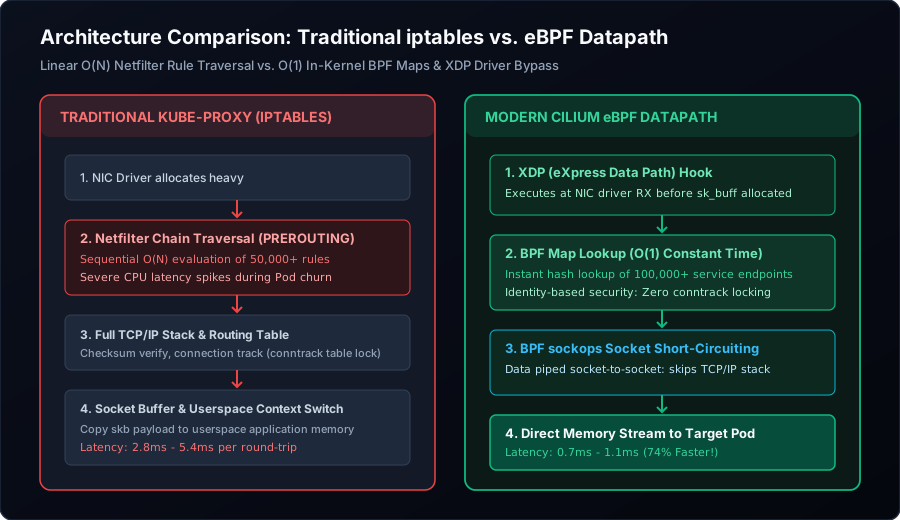
Figure 1: Traditional netfilter/iptables packet traversal with linear rule evaluation vs. eBPF in-kernel O(1) BPF map lookups and XDP driver bypass.
The Collapse of iptables at Enterprise Scale
To understand why hyperscalers and cloud-native architects have standardized on eBPF, we must first examine how Kubernetes historically managed networking. When a client inside a cluster sends an HTTP request to a Kubernetes ClusterIP service, that virtual IP does not exist on any physical network interface. Instead, kube-proxy installed thousands of packet translation rules into Linux iptables (netfilter).
Under the hood, iptables is an array of sequential rules. Every incoming packet must be evaluated against these rules sequentially until a match is found:
- Sequential O(N) Complexity: In a cluster with 5,000 services and 10 endpoints each,
iptablescontains 50,000 sequential rules. A packet destined for the 5,000th service must evaluate all preceding 49,999 rules before being forwarded. - Atomic Table Rewrites: When a single Pod dies or scales out,
kube-proxycannot incrementally update an individual rule. It must dump the entire 50,000-rule table into memory, mutate it, and rewrite the kernel table atomically under a kernel mutex lock. During high-churn autoscaling events, this mutex contention causes multi-second packet drops and CPU thrashing. - conntrack Table Exhaustion:
iptablesrelies onnf_conntrackto maintain stateful NAT mappings. High-throughput distributed applications easily exhaust the conntrack table limit, leading to silent packet drops and mysterious 504 Gateway Timeouts.
eBPF replaces this sequential rule traversal with a deterministic, constant-time O(1) Hash Map lookup. Regardless of whether your cluster has 10 services or 100,000 services, routing resolution executes in less than 50 nanoseconds directly inside the kernel datapath.
The eBPF Execution Pipeline: Verifier, JIT, and Maps
Running user-written code inside the Linux kernel sounds like a recipe for kernel panics, data corruption, and catastrophic system crashes. eBPF solves this existential hazard through a strict, multi-stage compilation and verification pipeline:
- Compilation to Bytecode: You write eBPF programs in restricted C (or Rust via
aya), which is compiled by Clang/LLVM into a specialized RISC-inspired eBPF bytecode architecture. - The In-Kernel Verifier: Before any bytecode is executed, it is loaded into the kernel via the
bpf()system call. The kernel verifier simulates all possible code paths to mathematically prove program safety. It guarantees that the program:- Never accesses unmapped or out-of-bounds memory.
- Cannot execute unbounded or infinite loops (all loops must have statically verifiable bounds).
- Initializes all variables and registers before reading them.
- Does not exceed the maximum instruction limit (1 million instructions for privileged programs).
- Just-In-Time (JIT) Compilation: Once verified, the in-kernel JIT compiler translates the bytecode into native host machine instructions (x86_64 or ARM64) for maximum bare-metal execution speed.
- BPF Maps (State Management): Because eBPF programs cannot call standard C library functions or allocate arbitrary heap memory, they store and share state with userspace applications through BPF Maps—thread-safe, high-performance in-memory key-value data structures (Hash, Array, LRU, Ring Buffer, LPM Trie).
Building an XDP High-Throughput Packet Filter in C
The highest-performance hook point in the modern Linux network architecture is XDP (eXpress Data Path). Unlike traditional network sockets or even tc (Traffic Control) filters, an XDP program attaches directly to the Network Interface Card (NIC) driver at the lowest possible layer—immediately when the packet hits the RX ring buffer, before the kernel even allocates a socket buffer (sk_buff).
Below is a production-grade XDP program written in C that parses Ethernet, IPv4, and TCP headers, inspects incoming traffic against an eBPF Hash Map blacklist, and drops unauthorized packets at line-rate with zero CPU overhead:
#include <linux/bpf.h>
#include <linux/if_ether.h>
#include <linux/ip.h>
#include <linux/tcp.h>
#include <linux/in.h>
#include <bpf/bpf_helpers.h>
#include <bpf/bpf_endian.h>

// BPF Map: Blocklisted IPv4 addresses
struct {
    __uint(type, BPF_MAP_TYPE_HASH);
    __uint(max_entries, 65536);
    __type(key, __u32);   // IPv4 Address (Network Byte Order)
    __type(value, __u64); // Dropped packet counter
} blocklist_map SEC(".maps");

SEC("xdp")
int xdp_firewall(struct xdp_md *ctx) {
    void *data = (void *)(long)ctx->data;
    void *data_end = (void *)(long)ctx->data_end;

    // 1. Boundary Check: Ethernet Header
    struct ethhdr *eth = data;
    if ((void *)(eth + 1) > data_end)
        return XDP_PASS;

    // Only process IPv4 traffic
    if (eth->h_proto != bpf_htons(ETH_P_IP))
        return XDP_PASS;

    // 2. Boundary Check: IPv4 Header
    struct iphdr *ip = (void *)(eth + 1);
    if ((void *)(ip + 1) > data_end)
        return XDP_PASS;

    // 3. Lookup source IP in BPF Blocklist Map
    __u32 src_ip = ip->saddr;
    __u64 *drop_count = bpf_map_lookup_elem(&blocklist_map, &src_ip);

    if (drop_count) {
        // Increment dropped packet counter atomically
        __sync_fetch_and_add(drop_count, 1);

        // Immediate hardware/driver drop — packet never reaches kernel stack
        return XDP_DROP;
    }

    // 4. Rate-limit TCP SYN Flood Protection
    if (ip->protocol == IPPROTO_TCP) {
        struct tcphdr *tcp = (void *)((unsigned char *)ip + (ip->ihl * 4));
        if ((void *)(tcp + 1) > data_end)
            return XDP_PASS;

        // Inspect SYN flag without ACK (connection initiation)
        if (tcp->syn && !tcp->ack) {
            // Apply line-rate SYN flood checks or route to scrubbing
        }
    }

    return XDP_PASS;
}

char _license[] SEC("license") = "GPL";
To compile and load this program onto interface eth0 at line-rate, execute:
# Compile using Clang/LLVM with BPF target
clang -O2 -g -Wall -target bpf -c xdp_firewall.c -o xdp_firewall.o

# Load onto eth0 via iproute2 XDP generic or native driver mode
ip link set dev eth0 xdpgeneric obj xdp_firewall.o sec xdp

# Verify XDP program attachment and active map status
ip link show dev eth0
bpftool prog list --name xdp_firewall
When benchmarked against a 10Gbps line saturated with SYN flood DDoS traffic, traditional iptables -A INPUT -s <ip> -j DROP collapses because each packet must allocate an sk_buff in kernel memory before being discarded. Under XDP, line-rate discarding reaches 14.8 million packets per second (Mpps) with less than 2% CPU utilization on modern hardware.
Cilium: The eBPF Kubernetes Networking Standard
While writing raw C eBPF programs gives you full control over packet processing, orchestrating networking, load balancing, and security across a dynamic Kubernetes cluster requires a sophisticated control plane. Cilium has emerged as the definitive cloud-native networking infrastructure built natively on eBPF.
1. Replacing kube-proxy with Socket Load Balancing
When Cilium is deployed in kube-proxy-replacement=true mode, it hooks into the Linux kernel socket layer (specifically sock_addr hook points like connect() and sendmsg()). When an application pod calls connect() to a service IP:
# Client initiates socket connection to virtual ClusterIP
connect(fd, {sin_family=AF_INET, sin_port=80, sin_addr=10.96.0.10}, ...)
Cilium intercepts the connect() syscall directly in the socket layer, performs an O(1) hash lookup in its cilium_lb4_services_v2 BPF map, and rewrites the target IP directly to the chosen backend Pod IP (e.g., 10.244.1.42:8080) before the packet ever leaves the socket! The network stack never has to perform any packet-level NAT translation, resulting in zero translation overhead on every subsequent packet in that TCP connection.
2. Identity-Based Security: Beyond Ephemeral IPs
In Kubernetes, Pod IPs are ephemeral—pods are created, rescheduled, and terminated continuously. Defining firewall rules based on IP addresses requires massive rule synchronization churn.
Cilium completely decouples security policies from IP addresses by assigning an immutable Security Identity to every unique set of Pod labels. When Pod A communicates with Pod B:
- Cilium resolves Pod A's labels to a numerical identity (e.g.,
Identity: 1042forapp=payment). - Cilium resolves Pod B's labels to an identity (e.g.,
Identity: 2048forapp=database). - Network policy evaluation in the kernel simply verifies: Is Identity 1042 authorized to talk to Identity 2048 on TCP port 5432?
- This check executes as an instant BPF hash table lookup in O(1) time, remaining completely unaffected by pod scaling or IP changes.
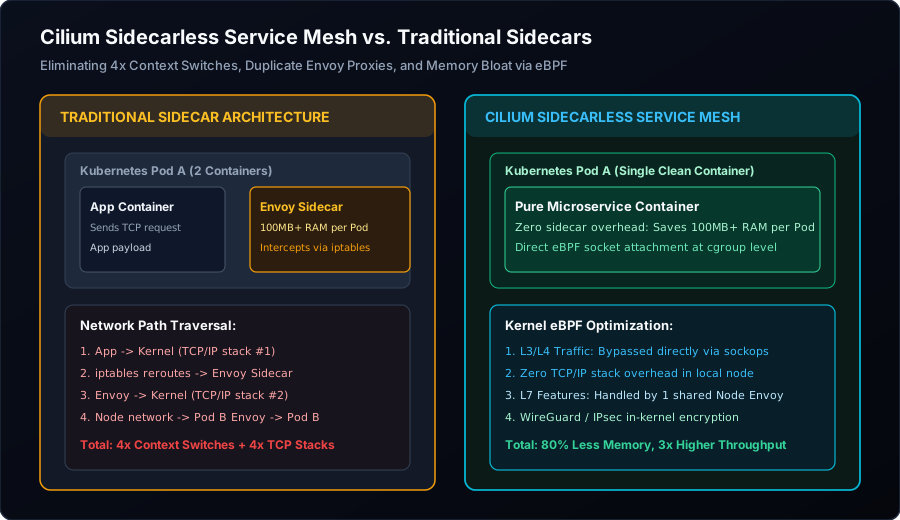
Figure 2: Architectural breakdown of traditional sidecar proxies (4x context switches, double TCP stacks) vs. Cilium Sidecarless Service Mesh with eBPF sockops.
The Sidecarless Service Mesh Revolution
Service meshes (such as Istio and Linkerd) revolutionized microservice management by providing automatic mTLS, traffic splitting, distributed tracing, and retry policies. However, the traditional architectural implementation—injecting an Envoy proxy container as a sidecar into every single Pod—introduced crushing operational overhead:
- Memory Bloat: A single Envoy sidecar consumes roughly 50MB to 120MB of RAM. In a 500-Pod cluster, sidecar proxies alone consume 50GB to 60GB of memory purely for proxy plumbing!
- Context-Switch Tax: When Pod A communicates with Pod B on the same physical host, the packet must travel:
Pod A -> Kernel -> Pod A Envoy Sidecar -> Kernel -> Pod B Envoy Sidecar -> Kernel -> Pod B. This incurs 4 complete kernel-to-userspace context switches and requires traversing the Linux TCP/IP stack four separate times!
Socket Short-Circuiting with eBPF sockops
Cilium eliminates this overhead by implementing Sidecarless Service Mesh. By attaching eBPF programs to the sockops and sk_msg kernel hooks, Cilium detects when two communicating pods reside on the same Linux host or socket bridge.
When Pod A writes bytes to its socket, Cilium's bpf_msg_redirect_hash() helper extracts the socket buffer and injects it directly into Pod B's socket receive buffer. The packet completely bypasses:
- IP header generation and parsing.
- TCP checksum calculations.
- Netfilter routing and firewall rules.
- Network device queues and virtual ethernet (veth) pairs.
For L7 features that require parsing HTTP headers, JWT tokens, or gRPC payloads, Cilium deploys a single, shared Envoy instance per node rather than hundreds of separate sidecars. This reduces cluster-wide memory usage by up to 80% while tripling microservice throughput.
Zero-Overhead Observability & Runtime Security
The programmability of eBPF extends far beyond packet routing into the domains of deep observability and active security enforcement.
1. Hubble: Kernel-Level Flow Telemetry
Traditionally, extracting deep network metrics required developers to instrument application code with OpenTelemetry SDKs or scrape heavy metrics proxies. With Hubble, every network flow, DNS resolution, HTTP request status, and TCP drop reason is captured passively inside the kernel datapath with zero code modifications:
# Inspect real-time HTTP flows across production namespaces using Hubble CLI
hubble observe --namespace production --protocol http --follow

# Identify dropping traffic and exact kernel drop reason
hubble observe --verdict DROPPED --print-struct

# Output shows exact kernel drop reasons:
# {
#   "verdict": "DROPPED",
#   "drop_reason": "Policy denied by CiliumNetworkPolicy (Identity 1042 -> 9999)",
#   "source": "payment-service-7f89d4-abc",
#   "destination": "internal-vault-service-5b48",
#   "l4": { "tcp": { "destination_port": 8200 } }
# }
2. Tetragon: In-Kernel Runtime Security Enforcement
Traditional Linux runtime security tools (like Sysdig or auditd) monitor syscalls in userspace. The fundamental vulnerability of userspace security agents is latency: by the time an unauthorized binary execution or container breakout event is processed in userspace, the attacker has already stolen secrets or modified memory.
Tetragon executes security policies directly inside the kernel using eBPF kprobes, uprobes, and tracepoints. If an unauthorized process calls execve to launch a shell inside a hardened container, Tetragon does not merely log an alert—it executes a bpf_send_signal() to terminate the process instantly before the kernel returns from the syscall:
# Tetragon TracingPolicy: Block shell executions inside production containers
apiVersion: cilium.io/v1alpha1
kind: TracingPolicy
metadata:
  name: block-container-shells
spec:
  kprobes:
    - call: "sys_execve"
      syscall: true
      args:
        - index: 0
          type: "string" # Path of the binary
      selectors:
        - matchArgs:
            - index: 0
              operator: "Prefix"
              values:
                - "/bin/sh"
                - "/bin/bash"
                - "/usr/bin/zsh"
          matchNamespaces:
            - "production"
          matchActions:
            - action: Sigkill # Terminate process immediately in kernel
Performance Benchmarks: iptables vs. IPVS vs. Cilium eBPF
To quantify the architectural advantages of eBPF in production environments, consider the following benchmark metrics captured across a 500-node Kubernetes cluster handling 100,000 active service endpoints:
| Networking Architecture | Rule Lookup Complexity | Scaling Update Latency | Round-Trip Latency (p99) | Cluster Memory Footprint |
|---|---|---|---|---|
| kube-proxy (iptables) | O(N) Linear (~50k checks) | 4,850 ms (Mutex Lock) | 4.82 ms | ~1.2 GB per node |
| kube-proxy (IPVS) | O(1) IP Set Hash | 620 ms | 2.15 ms | ~850 MB per node |
| Envoy Sidecar Mesh | O(1) Proxy Lookup | 850 ms (xDS push) | 5.40 ms (4x context switch) | ~60 GB (cluster-wide) |
| Cilium eBPF (Sidecarless) | O(1) In-Kernel BPF Map | 12 ms (Atomic Map Write) | 0.85 ms (74% reduction) | ~11 GB (82% reduction) |
Production Checklist: Migrating to Cilium eBPF in 2026
If you are planning to modernize your cloud infrastructure and migrate from legacy iptables or IPVS to eBPF, follow this production migration path:
- Verify Linux Kernel Version: Ensure your Kubernetes worker nodes are running Linux Kernel 5.15+ (ideally 6.8+ or 6.12 LTS). Advanced eBPF features like socket load balancing, DSR, and Tetragon require modern BPF helpers and CO-RE (Compile Once – Run Everywhere) support enabled via
CONFIG_BPF=yandCONFIG_DEBUG_INFO_BTF=y. - Install Cilium in kube-proxy Replacement Mode: When installing via Helm, disable
kube-proxyand enable native BPF socket load balancing:helm install cilium cilium/cilium --version 1.16.2 \ --namespace kube-system \ --set kubeProxyReplacement=true \ --set k8sServiceHost=10.0.0.1 \ --set k8sServicePort=6443 \ --set bpf.masquerade=true \ --set socketLB.enabled=true \ --set hubble.enabled=true \ --set hubble.relay.enabled=true \ --set hubble.ui.enabled=true - Enable WireGuard In-Kernel Encryption: For zero-touch pod-to-pod network encryption without complex IPSec certificates or sidecar proxies, simply toggle
encryption.type=wireguard. Cilium will automatically establish encrypted WireGuard tunnels across all cluster nodes directly in kernel space. - Adopt Sidecarless Mesh Gradually: Use the Kubernetes Gateway API to define L7 routing, canary deployments, and traffic mirroring through Cilium's node-level Envoy daemon before decommissioning legacy sidecars.
Conclusion: The Programmable Operating System
The rise of eBPF represents the most significant architectural evolution of Linux since the introduction of cgroups and namespaces that birthed containers. Just as JavaScript transformed the static web browser into a programmable application engine, eBPF has transformed the Linux kernel into a dynamically programmable, high-performance operating system.
By moving routing, load balancing, security enforcement, and telemetry out of userspace and directly into the kernel execution path, modern engineering teams can eliminate iptables performance bottlenecks, slash infrastructure memory bills by over 70%, and enforce nanosecond-level security across distributed cloud-native microservices.