Table of Contents (Jump to section)
In a monolithic architecture backed by a single relational database, managing transactional data consistency is straightforward. If a customer places an order, the application opens a local database transaction, writes an entry to the orders table, deducts inventory from the stock table, and records an invoice in the payments table. If any step fails—due to insufficient inventory, an invalid coupon, or a transient constraint violation—the relational database management system (RDBMS) executes a complete, atomic rollback. Thanks to ACID guarantees (Atomicity, Consistency, Isolation, Durability), the system never enters a corrupted or partial state.
However, when engineering teams decompose monolithic architectures into distributed microservices adopting the Database-per-Service pattern, that safety net disappears entirely. In a decoupled architecture, the Order Service owns an independent PostgreSQL database, the Inventory Service manages a Redis or DynamoDB cluster, and the Payment Service communicates with an external Stripe API. There is no shared database engine to coordinate locks or enforce relational foreign keys.
When an operation spans multiple independent network endpoints and datastores, achieving consistency transforms from a trivial database feature into one of the most difficult engineering problems in computer science. Early attempts to solve this using traditional Two-Phase Commit (2PC / XA) protocols collapsed in high-throughput cloud environments under the weight of blocking locks, coordinator failures, and devastating network partition latencies.
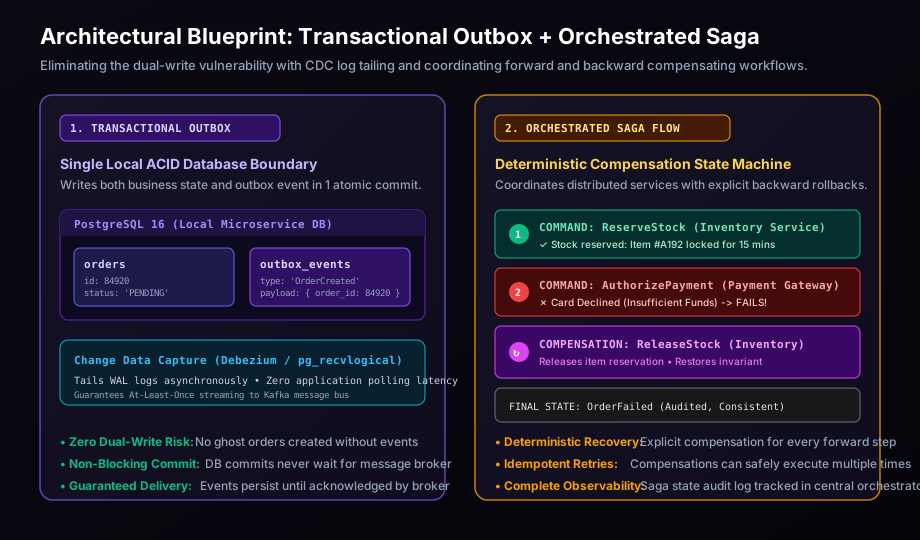
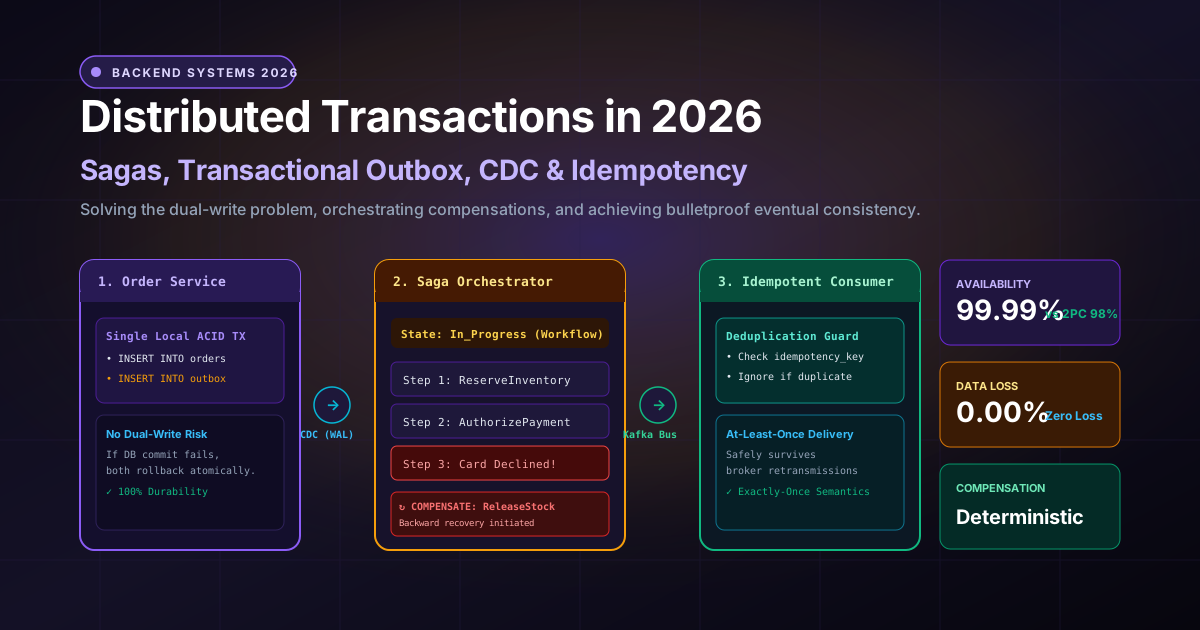
In 2026, enterprise backend systems have standardized on an elegant, resilient architectural pairing: The Saga Pattern (to coordinate multi-step workflows via explicit forward and backward compensating actions) paired with The Transactional Outbox Pattern via Change Data Capture (CDC) (to eliminate the deadly dual-write vulnerability). In this comprehensive masterclass, we dissect why distributed ACID transactions fail, solve the dual-write crisis, design deterministic compensating state machines, implement bulletproof idempotency guards, and author a production-ready Saga and Outbox implementation in modern C# and .NET 9.
---1. The Death of Two-Phase Commit (2PC) in Cloud-Native Systems
To understand modern distributed architectures, one must first recognize why traditional distributed transactions failed. In the 1980s and 1990s, the database industry championed the Two-Phase Commit (2PC) protocol, standardized by the X/Open XA specification. 2PC attempts to provide distributed ACID guarantees across multiple distinct databases through a centralized transaction coordinator in two distinct steps:
- Prepare Phase: The coordinator asks all participating databases (nodes): "Can you commit this transaction?" Each node acquires local database locks on all involved rows, writes changes to its local redo log, and votes
YESorNO. - Commit Phase: If every participant voted
YES, the coordinator sends a globalCOMMITmessage. If even a single node votesNOor fails to respond within a timeout window, the coordinator issues a globalROLLBACK.
| Failure Vector in 2PC | System Consequence | Cloud-Native Reality |
|---|---|---|
| Coordinator Crash in Commit Phase | Participant nodes remain locked indefinitely waiting for the commit verdict. | System availability drops to zero; cascading thread pool exhaustion. |
| Network Partition (CAP Theorem) | Partitions block the prepare/commit phase from completing. | Latency spikes by orders of magnitude; database connections saturate. |
| Lock Holding Duration | Exclusive row locks must be held across multiple network round-trips. | Database throughput degrades by 90% or more under high concurrency. |
| Heterogeneous Polyglot Services | Requires every datastore (Kafka, Redis, Stripe, Elasticsearch) to implement XA. | Third-party APIs and modern message brokers do not support XA transactions. |
Under Eric Brewer's CAP Theorem, a distributed system experiencing a network partition must choose between Consistency (C) and Availability (A). 2PC aggressively prioritizes strict consistency by sacrificing availability. In cloud environments where transient network blips and micro-outages are mathematical certainties, 2PC turns a single slow service into a global system outage. Modern systems therefore embrace Eventual Consistency (BASE: Basically Available, Soft state, Eventual consistency) through Sagas.
---2. The Dual-Write Vulnerability: Why Naive Event Publishing Fails
When transitioning from 2PC to event-driven architectures, developers frequently fall into the most dangerous antipattern in distributed systems: The Dual-Write Bug. Consider this seemingly harmless ASP.NET Core controller endpoint:
// ANTIPATTERN: The Dual-Write Disaster
[HttpPost("checkout")]
public async Task<IActionResult> CreateOrder([FromBody] OrderRequest request)
{
    // 1. Write to local relational database
    var order = new Order { Id = Guid.NewGuid(), Total = request.Total, Status = "Pending" };
    _dbContext.Orders.Add(order);
    await _dbContext.SaveChangesAsync(); // Commit Local DB Transaction

    // 2. Publish event to message broker over the network
    var orderCreatedEvent = new OrderCreatedEvent(order.Id, order.Total);
    await _messageBus.PublishAsync(orderCreatedEvent); // Network Call to Kafka / RabbitMQ

    return Ok(new { orderId = order.Id });
}
This code contains a fatal flaw. Writing to the database and sending an event to a message broker are two independent network actions. They cannot be executed within a single atomic boundary. Under production conditions, this code will inevitably desynchronize:
- Crash Mode 1 (The Ghost Order): The local database commits the order to disk successfully. But before
_messageBus.PublishAsync()executes, the application server container restarts (OOM kill, host reboot, pod migration). The order exists in the database, but the event is never published. The customer's credit card is never charged, inventory is never reserved, and the order languishes in a permanent zombie state. - Crash Mode 2 (The Phantom Charge): Suppose a developer attempts to fix this by flipping the order: publishing the message first, then saving to the database. If
_messageBus.PublishAsync()succeeds, but_dbContext.SaveChangesAsync()fails due to a database constraint violation or transient network disconnection, the event has already entered Kafka. Downstream payment services charge the customer's card for an order that does not exist in the primary database! - Crash Mode 3 (The Network Timeout Trap): If
_messageBus.PublishAsync()throws aTimeoutException, did the broker receive and persist the message before the socket timed out, or did it fail before ingestion? You cannot know. If you retry, you risk publishing duplicate events; if you don't retry, you risk losing the message entirely.
3. The Solution: The Transactional Outbox Pattern with Change Data Capture (CDC)
The Transactional Outbox Pattern solves the dual-write problem by leveraging the one thing a single microservice can do perfectly: execute an atomic transaction within its own local database. Instead of publishing directly to an external message broker over the network, the service writes both the domain entity and an event record into a dedicated outbox_messages table within the same local ACID database transaction.
-- Production Outbox Schema in PostgreSQL
CREATE TABLE outbox_messages (
    id UUID PRIMARY KEY,
    aggregate_type VARCHAR(64) NOT NULL,
    aggregate_id VARCHAR(64) NOT NULL,
    event_type VARCHAR(128) NOT NULL,
    payload JSONB NOT NULL,
    trace_context JSONB NOT NULL,
    created_at TIMESTAMPTZ NOT NULL DEFAULT NOW(),
    processed_at TIMESTAMPTZ NULL
);

CREATE INDEX idx_outbox_unprocessed
ON outbox_messages (created_at)
WHERE processed_at IS NULL;
Because the insert into orders and the insert into outbox_messages occur within the same local transaction, atomicity is guaranteed by the relational database engine. If the database commit succeeds, both records exist; if the server crashes or the transaction aborts, neither record exists. The dual-write vulnerability is completely eliminated.
Publishing from the Outbox: Polling vs. Log-Tailing CDC
Once events are safely committed to the outbox table, how do they get transferred to the message broker? In modern architectures, there are two approaches:
| Architectural Metric | Polling Publisher (Background Worker) | Change Data Capture (Debezium / WAL) |
|---|---|---|
| Mechanism | Background thread executes SELECT ... FOR UPDATE SKIP LOCKED every 500ms |
External connector directly tails the database transaction log (e.g. PostgreSQL WAL) |
| Publishing Latency | 200ms - 1,000ms (governed by poll interval) | 2ms - 15ms (near-instantaneous event streaming) |
| Database Overhead | High: continuous read/write cycles, table bloat, index churn | Near Zero: reads sequential binary disk log without querying tables |
| Operational Complexity | Low: standard application background service | Medium: requires Kafka Connect, Debezium, and replication slot monitoring |
| Recommended Production Scale | < 100 events per second | 1,000+ events per second (Enterprise Standard) |
In high-throughput 2026 architectures, Change Data Capture (CDC) via tools like Debezium or native PostgreSQL logical decoding is the undisputed standard. Because Debezium reads directly from PostgreSQL's Write-Ahead Log (WAL), the primary database engine performs zero index updates or polling queries, unlocking massive transaction throughput.
---4. The Saga Pattern: Orchestration vs. Choreography
While the Transactional Outbox ensures that messages are reliably delivered from a single service to the event bus, it does not coordinate a multi-service business process. This is where the Saga Pattern operates.
A Saga is a sequence of local transactions where each transaction updates data within a single service. The first transaction is initiated by an external request. Each subsequent step is triggered by the completion of the previous step. If a step fails, the Saga executes a series of compensating transactions that undo the changes made by the preceding local transactions in reverse order.
Choreography: Event-Driven Reaction
In a choreographed saga, there is no central coordinator. Each service listens for events published by other services and decides independently whether to act:
- Order Service commits an order and publishes
OrderCreated. - Inventory Service receives
OrderCreated, reserves stock, and publishesStockReserved. - Payment Service receives
StockReserved, charges the card, and publishesPaymentCaptured.
The Choreography Trap: While simple for 2-step workflows, choreography rapidly devolves into "event pinball" as workflows expand to 5 or more steps. When an error occurs at step 4, tracking which services have emitted which compensating events requires inspecting multiple distributed logs. Workflows suffer from circular event dependencies, and visualizing the overall state of an order becomes nearly impossible.
Orchestration: Centralized Workflow Coordination
In an orchestrated saga, a dedicated Saga Orchestrator (implemented using tools like Temporal, Zeebe, MassTransit, or a custom state machine) explicitly coordinates every step. The orchestrator sends direct command messages to participant services and awaits reply events:
// Saga Orchestrator Execution State Record
{
  "sagaId": "9d7e48b1-36f2-4c28-971c-4b533e08f220",
  "correlationId": "ORD-2026-89412",
  "currentState": "AwaitingPayment",
  "executedSteps": [
    { "step": "ReserveInventory", "status": "Success", "compensated": false }
  ],
  "pendingStep": "AuthorizePayment",
  "timeoutAt": "2026-10-17T06:15:00Z"
}
If the Payment Service returns PaymentFailed, the orchestrator immediately evaluates its state table and issues an explicit ReleaseInventoryCommand to the Inventory Service. Orchestration is the recommended production pattern in 2026 because it provides an auditable single source of truth, eliminates distributed state confusion, and simplifies complex timeout and retry policies.
5. Compensating Transactions: Semantic Rollbacks in the Real World
A fundamental law of distributed systems is that compensating transactions are not identical to database rollbacks. When a relational database rolls back a transaction, it restores the physical bytes on disk as though the transaction never occurred. In a distributed saga, the preceding local transactions have already committed to their respective databases and may have already been observed by external systems or users.
Therefore, a compensating transaction is a semantic rollback: a new forward transaction that counterbalances the business impact of a previously committed step.
| Forward Transaction | Compensating Action | Irreversible Side-Effect Handling |
|---|---|---|
| Reserve Inventory (Lock SKU #4892) | Release Inventory (Unlock SKU #4892) | Fully reversible; restore stock counter. |
| Charge Credit Card ($150.00) | Issue Refund ($150.00 via Stripe API) | Creates a separate refund ledger entry; cannot erase original charge statement. |
| Send Confirmation Email | Send Cancellation Email | Physical action is irreversible; counterbalance with clarifying communication. |
| Dispatch Delivery Driver | Recall / Reassign Courier | Physical movement; may incur operational cancellation fee. |
The Pivot Step Rule
Every well-designed Saga contains a Pivot Step. The pivot step is the point of no return: once the pivot step commits, the Saga cannot be compensated and must complete forward, even if it requires repeated retries or manual intervention.
- Compensatable Steps: Steps that precede the pivot step. Must have guaranteed compensating actions.
- The Pivot Step: The decisive business action (e.g., executing the bank transfer or finalizing a flight booking).
- Retriable Steps: Steps that follow the pivot step (e.g., sending receipts, generating invoices). These steps must never fail permanently; they must retry until they succeed.
6. Idempotency & Deduplication: The Non-Negotiable Foundation
In distributed systems, network guarantees are at-least-once. Message brokers will re-deliver messages when consumer acknowledgments time out. Outbox workers will re-publish messages when pods restart mid-flight. Sagas will retry failed commands upon recovering from transient network drops.
If your consumer microservices are not strictly idempotent, your system will charge credit cards multiple times, double-deduct inventory, and corrupt business ledgers. A consumer is idempotent if executing an action multiple times produces the exact same side-effects as executing it once.
The Deduplication Table Pattern
The most robust technique for guaranteeing idempotency is the Transactional Inbox / Deduplication Table. Before processing any incoming message, the consumer attempts to insert the message's unique idempotency_key (typically a deterministic UUIDv7 or correlation ID) into a dedicated database table within a local transaction:
CREATE TABLE processed_messages (
    message_id UUID PRIMARY KEY,
    consumer_name VARCHAR(128) NOT NULL,
    processed_at TIMESTAMPTZ NOT NULL DEFAULT NOW()
);
If the message_id has already been recorded, the unique primary key constraint triggers a duplicate key violation. The consumer detects this, immediately skips execution of business logic, acknowledges the message to the broker, and returns HTTP 200/ACK. No duplicate side-effects occur.
7. Production Implementation: Building Outbox & Idempotency in .NET 9
Let us implement a production-grade Transactional Outbox pattern in modern C# and ASP.NET Core 8 / .NET 9 using Entity Framework Core and a dedicated background publisher worker.
1. Defining the Outbox Entity and DbContext Configuration
using System.Text.Json;
using Microsoft.EntityFrameworkCore;

namespace Mangobaz.Web.Data.Entities;

public class OutboxMessage
{
    public Guid Id { get; set; } = Guid.NewGuid();
    public string AggregateType { get; set; } = string.Empty;
    public string AggregateId { get; set; } = string.Empty;
    public string EventType { get; set; } = string.Empty;
    public string Payload { get; set; } = string.Empty;
    public DateTime CreatedAt { get; set; } = DateTime.UtcNow;
    public DateTime? ProcessedAt { get; set; }
    public string? ErrorMessage { get; set; }
}

public class Order
{
    public Guid Id { get; set; }
    public string CustomerId { get; set; } = string.Empty;
    public decimal TotalAmount { get; set; }
    public string Status { get; set; } = "Pending";
    public DateTime CreatedAt { get; set; } = DateTime.UtcNow;
}
2. The Atomic Unit of Work Service
Notice how our checkout service commits both the Order entity and the OutboxMessage in a single call to SaveChangesAsync():
public interface IOrderService
{
    Task<Guid> CreateOrderAsync(string customerId, decimal totalAmount, CancellationToken ct);
}

public class OrderService : IOrderService
{
    private readonly ApplicationDbContext _db;

    public OrderService(ApplicationDbContext db)
    {
        _db = db;
    }

    public async Task<Guid> CreateOrderAsync(string customerId, decimal totalAmount, CancellationToken ct)
    {
        var orderId = Guid.NewGuid();

        var order = new Order
        {
            Id = orderId,
            CustomerId = customerId,
            TotalAmount = totalAmount,
            Status = "Pending"
        };

        // Create domain event
        var domainEvent = new
        {
            OrderId = orderId,
            CustomerId = customerId,
            Amount = totalAmount,
            Timestamp = DateTime.UtcNow
        };

        // Create Outbox message inside the same transaction
        var outboxMessage = new OutboxMessage
        {
            Id = Guid.NewGuid(),
            AggregateType = "Order",
            AggregateId = orderId.ToString(),
            EventType = "OrderCreated",
            Payload = JsonSerializer.Serialize(domainEvent),
            CreatedAt = DateTime.UtcNow
        };

        // Add both to EF Core change tracker
        _db.Orders.Add(order);
        _db.OutboxMessages.Add(outboxMessage);

        // Commit both in ONE single local ACID transaction
        await _db.SaveChangesAsync(ct);

        return orderId;
    }
}
3. Resilient Outbox Background Publisher Worker
For applications where CDC is not yet configured, an asynchronous background worker processes unpublished outbox records using batching and explicit transaction isolation:
using Microsoft.Extensions.Hosting;
using Microsoft.Extensions.Logging;

public class OutboxPublisherWorker : BackgroundService
{
    private readonly IServiceScopeFactory _scopeFactory;
    private readonly ILogger<OutboxPublisherWorker> _logger;

    public OutboxPublisherWorker(IServiceScopeFactory scopeFactory, ILogger<OutboxPublisherWorker> logger)
    {
        _scopeFactory = scopeFactory;
        _logger = logger;
    }

    protected override async Task ExecuteAsync(CancellationToken stoppingToken)
    {
        while (!stoppingToken.IsCancellationRequested)
        {
            try
            {
                using var scope = _scopeFactory.CreateScope();
                var db = scope.ServiceProvider.GetRequiredService<ApplicationDbContext>();
                var messageBus = scope.ServiceProvider.GetRequiredService<IMessageBus>();

                // Fetch batch of unprocessed messages
                var messages = await db.OutboxMessages
                    .Where(m => m.ProcessedAt == null)
                    .OrderBy(m => m.CreatedAt)
                    .Take(50)
                    .ToListAsync(stoppingToken);

                foreach (var message in messages)
                {
                    try
                    {
                        // Publish to external message broker (Kafka, RabbitMQ, Azure Service Bus)
                        await messageBus.PublishAsync(message.EventType, message.Payload, stoppingToken);

                        message.ProcessedAt = DateTime.UtcNow;
                    }
                    catch (Exception ex)
                    {
                        _logger.LogError(ex, "Failed to dispatch outbox message {Id}", message.Id);
                        message.ErrorMessage = ex.Message;
                    }
                }

                if (messages.Count > 0)
                {
                    await db.SaveChangesAsync(stoppingToken);
                }
            }
            catch (Exception ex)
            {
                _logger.LogError(ex, "Error in outbox publisher loop");
            }

            // Non-blocking poll delay
            await Task.Delay(TimeSpan.FromMilliseconds(500), stoppingToken);
        }
    }
}
8. Architectural Checklist for 2026 Distributed Systems
Before launching a distributed microservice architecture into production, verify that your engineering team satisfies every requirement on this checklist:
| Architectural Criterion | Validation Test | Status |
|---|---|---|
| Database-per-Service Boundary | Are any two microservices reading or writing to the same SQL tables directly? If yes, split them. | Strictly Enforced |
| Zero Dual-Writes | Does any controller execute both a DB write and a bus.Publish() call? Replace with Outbox. |
Zero Dual-Writes |
| At-Least-Once Idempotency | Does every consumer record message IDs in a deduplication table before processing? | Mandatory |
| Explicit Saga State Auditing | Is there a centralized coordinator tracking forward actions and compensating status? | Orchestration Active |
| Dead-Letter Queues (DLQ) | If a compensating action permanently fails, does it trigger an alert to an on-call human SRE? | Monitored Alerting |
| Distributed Tracing (W3C) | Are traceparent headers propagated across outbox JSON payloads and message brokers? |
OpenTelemetry Integrated |
9. Conclusion
Distributed consistency in a microservices ecosystem cannot be achieved through naive optimistic code or archaic locking protocols like Two-Phase Commit. High-scale architectures must be designed under the assumption of failure: servers will crash mid-transaction, network packets will be delayed or duplicated, and downstream APIs will suffer transient outages.
By coupling the Transactional Outbox pattern (which ensures atomic persistence of state and events via local ACID transactions) with the Orchestrated Saga pattern (which coordinates multi-service workflows via deterministic forward steps and semantic compensating rollbacks), backend systems achieve bulletproof eventual consistency without sacrificing availability or throughput.
---Frequently Asked Questions (FAQ)
Q: What is the dual-write problem in distributed backend systems?
A: The dual-write problem occurs when an application attempts to write to two separate systems (such as a relational database and a message broker like Kafka) in a single request. Because these operations cannot share an atomic transaction, a crash or network partition between the two operations results in data desynchronization (e.g., an order saved in the DB without an event emitted, or an event sent for a failed DB write).
Q: Why is Two-Phase Commit (2PC) considered an anti-pattern in cloud microservices?
A: 2PC requires distributed nodes to hold exclusive database row locks across multiple network round-trips. In cloud environments, network latency and coordinator crashes cause cascading lock contention, collapsing system throughput. Furthermore, modern message brokers and third-party APIs (like payment gateways) do not support the XA protocol required for 2PC.
Q: What is the difference between Saga Choreography and Saga Orchestration?
A: In Choreography, microservices listen to events and react autonomously without a central director, which becomes difficult to trace and debug as workflows scale. In Orchestration, a centralized state machine explicitly sends command messages to participants, records progress, and coordinates compensating actions if a step fails, providing clear visibility and deterministic recovery.
Q: How does a compensating transaction differ from an ACID database rollback?
A: An ACID rollback physically erases uncommitted changes as though they never occurred. A compensating transaction is a semantic forward action that undoes the business consequences of a previously committed transaction (e.g., issuing a credit card refund to offset an earlier capture, or unlocking reserved warehouse inventory).