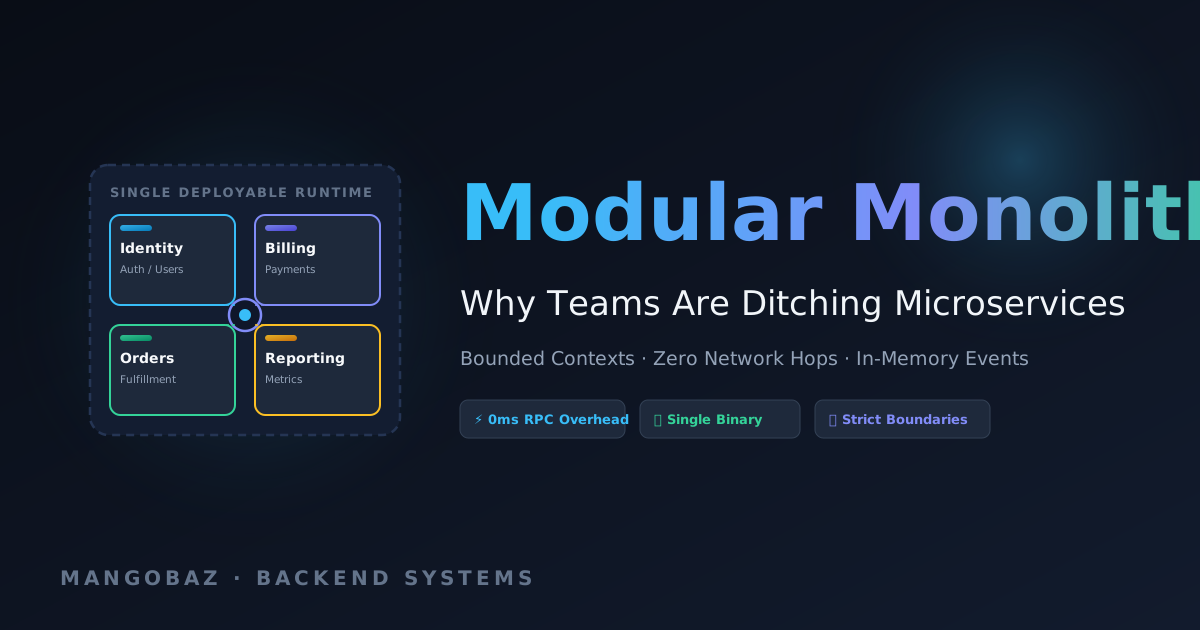
Between 2015 and 2022, the software engineering industry swallowed an unquestioned dogma: if you want to build scalable, modern cloud software, you must build microservices. Tech blogs, conference speakers, and vendor marketing campaigns insisted that monoliths were legacy relics and that splitting your system into dozens of independent deployable services was the only way to achieve developer velocity and high availability.
In 2026, the pendulum has decisively swung back. High-growth startups, scale-ups, and engineering giants alike (most famously evidenced by Amazon Prime Video saving over 90% in cloud infrastructure costs by replacing microservices with a consolidated monolithic architecture) have confronted the painful reality of the Microservice Tax. Teams that prematurely adopted microservices found themselves drowning in Kubernetes YAML, wrestling with distributed tracing, managing complex Saga patterns for cross-service consistency, and paying astronomical cloud networking bills for internal RPC serialization.
Enter the Modular Monolith: an architectural pattern that delivers the strict domain isolation, team autonomy, and clean boundaries of microservices, while completely eliminating the operational complexity, network latency, and deployment friction of distributed systems. In this architectural deep-dive, we examine why engineering teams are abandoning microservice sprawl, how to enforce compiler-level domain boundaries, how to structure in-memory event buses, and how to build a production-grade modular monolith in modern C# (.NET 8/9).
1. The Microservice Tax: Why Distributed Systems Fail Early Teams
To understand the resurgence of the modular monolith, one must honestly tally the hidden operational and architectural costs that microservices impose on an engineering organization.
The Fallacy of Free Network Calls
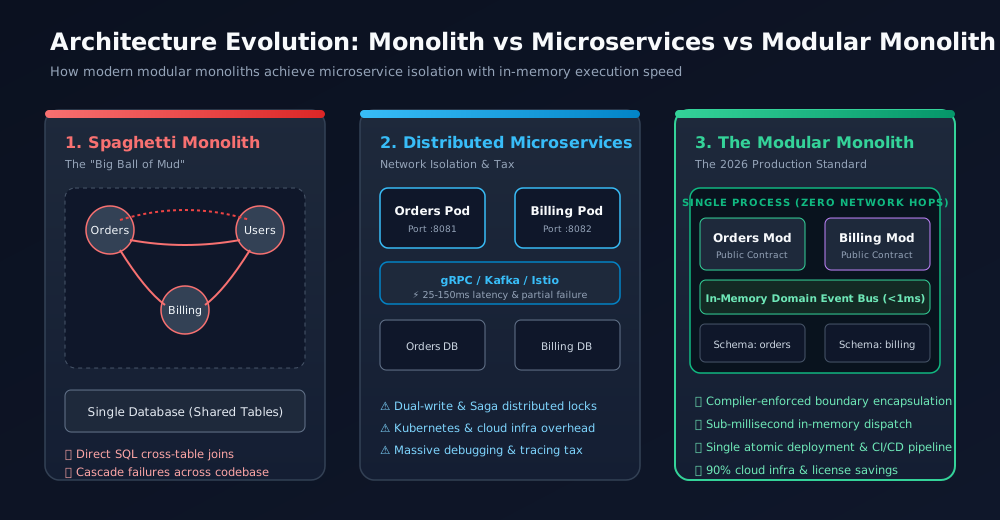
In a monolithic application, invoking a function or retrieving data across domain boundaries is an in-memory method call. In modern runtimes like .NET, Go, or Node.js, an in-process invocation takes nanoseconds and involves zero serialization overhead. The moment you extract that boundary into a separate microservice, every single interaction becomes an asynchronous network round-trip:
- DNS resolution and TCP/TLS connection handshakes.
- Payload serialization (JSON/Protobuf) and deserialization on both sides.
- Network latency (typically 5ms to 50ms per internal hop within a cloud VPC).
- HTTP gateway, service mesh (Istio/Linkerd), and reverse proxy overhead.
When an incoming HTTP request triggers a cascade of five internal microservice calls, your 99th percentile (p99) latency compounds exponentially. A single slow downstream pod degrades the entire user experience.
Distributed Transactions and Data Integrity Hell
In a relational database, you have the profound superpower of ACID transactions. If an order placement requires deducting inventory, debiting customer balance, and generating an invoice, you wrap the operations in a single database transaction. If any step fails, the database cleanly rolls back.
In a microservices architecture with a database-per-service, ACID transactions across services are impossible. Teams are forced to implement complex distributed coordination patterns:
- Two-Phase Commit (2PC): Notoriously brittle, blocking, and unsupported across modern cloud datastores.
- Saga Patterns (Choreographed or Orchestrated): Requires writing compensation actions (e.g., refunding an order if shipping reservation fails), handling out-of-order events, and managing eventual consistency anomalies that baffle product managers and customer support teams.
- Dual-Write Vulnerabilities: Attempting to write to a local database and publish a message to Kafka simultaneously inevitably leads to data desynchronization when one operation succeeds and the other crashes. Resolving this mandates the Transactional Outbox Pattern with polling background dispatchers.
The Cognitive and DevOps Burden
Instead of managing a single CI/CD pipeline and deployment artifact, a team with 20 microservices now manages 20 Dockerfiles, 20 Helm charts, independent secret rotations, service meshes, distributed log aggregation (OpenTelemetry/Jaeger), and multi-repository version alignment. For teams with fewer than 100 engineers, this operational overhead frequently consumes more than 40% of total engineering capacity.
2. What Is a Modular Monolith? (And What It Isn't)
A Modular Monolith is an architectural approach where the entire application runs as a single process, deployed from a single build pipeline into a single runtime environment, but is strictly decomposed internally into independent, decoupled functional modules.
It Is NOT a Spaghetti Monolith
It is vital to distinguish a modular monolith from the traditional "Big Ball of Mud." In a legacy monolith:
- Any class can import and instantiate any other class across the codebase.
- Controllers write raw SQL queries joining twelve tables across unrelated business domains.
- A bug fix in the billing logic inadvertently breaks user avatar uploads because of hidden shared state.
In contrast, a true modular monolith enforces strict encapsulation boundaries. A module is a logical island: it owns its domain models, its business rules, and its persistence layer. The rest of the codebase cannot access its internal classes or query its database tables directly.
3. Enforcing Boundaries: The Architectural Rules
A modular monolith succeeds or fails based on discipline. If boundaries are merely conceptual, developers facing tight deadlines will inevitably bypass them. Therefore, boundaries must be enforced at the compiler and build level.
Dimension Legacy Monolith Microservices Modular Monolith Deployment Units 1 deployable binary N independent services 1 deployable binary Domain Isolation None (spaghetti dependencies) Physical network boundaries Logical, compiler-enforced boundaries Cross-Module Latency < 1 microsecond (in-memory) 10 – 150 milliseconds (RPC) < 1 microsecond (in-memory) Data Consistency ACID Transactions Eventual Consistency (Sagas) ACID Transactions or In-Memory Events DevOps Complexity Low (single build/release) Very High (K8s, mesh, tracing) Low (single build/release) Refactoring Effort Trivial, but high regression risk Extremely painful across repos Trivial and safe via IDE refactoringRule 1: Assemblies and Internal Visibility
In .NET and modern compiled languages, you enforce boundaries using distinct projects (assemblies). Each business domain is structured into two projects:
[Module].Contracts: Contains only public interfaces, Data Transfer Objects (DTOs), and integration events. This is the only assembly that other modules are allowed to reference.[Module].Core: Contains domain entities, business logic, repositories, and database DbContexts. Every class in this assembly is marked asinternal. External assemblies cannot instantiate or reference them even if they try.
Rule 2: Database and Schema Separation
The most common fatal mistake in monoliths is database-level coupling: writing SQL queries that join tables belonging to different business modules. In a robust modular monolith, you enforce strict persistence boundaries:
- PostgreSQL / SQL Server Schemas: Isolate tables into domain schemas within the same database instance (e.g.,
orders.orders,billing.invoices,users.accounts). - Dedicated DbContexts: In Entity Framework Core, each module has its own
DbContextthat only registers entity configurations for its designated schema. TheOrdersDbContextcannot access theInvoicestable. - Foreign Key Discipline: Do not define database-level foreign key constraints across module schemas. Cross-module relationships are linked strictly by primitive IDs (e.g.,
CustomerId: Guid), exactly as they would be in a microservice architecture.
4. Inter-Module Communication: In-Memory Events & Contracts
How do modules collaborate when they cannot directly reference each other's internal classes?
Synchronous Queries via Public Contracts
When Module A synchronously requires information from Module B (e.g., the Orders module needs to verify whether a customer account is in good standing), Module A calls a public interface exposed in Users.Contracts:
// Users.Contracts/IUsersModule.cs
public interface IUsersModule
{
    Task<CustomerSummaryDto?> GetCustomerAsync(Guid customerId, CancellationToken ct = default);
}
The implementation lives internally inside Users.Core and is registered into the ASP.NET Core Dependency Injection container during startup. The calling module never sees the underlying User entity or the database query.
Asynchronous Decoupling via Domain Events
When an action in one module triggers side-effects in other modules, synchronous calling introduces unwanted temporal coupling. Instead, modules publish domain events across an in-memory mediator bus:
// Orders.Contracts/Events/OrderPlacedIntegrationEvent.cs
public record OrderPlacedIntegrationEvent(
    Guid OrderId,
    Guid CustomerId,
    decimal TotalAmount,
    DateTime PlacedAtUtc) : INotification;
When an order is created, the Orders module saves the order and publishes OrderPlacedIntegrationEvent. The Billing module and Notifications module independently implement event handlers to charge the card and send an email confirmation — all executed within the same process without a single external broker hop.
5. Production Implementation in C# (.NET 8/9)
Let us look at how clean and ergonomic this architecture is in modern ASP.NET Core.
Step 1: Module Bootstrap and Isolation
// Billing/BillingModuleExtensions.cs
namespace Mangobaz.Billing;

public static class BillingModuleExtensions
{
    public static IServiceCollection AddBillingModule(
        this IServiceCollection services,
        IConfiguration configuration)
    {
        // Register module-specific isolated database context
        services.AddDbContext<BillingDbContext>(options =>
            options.UseNpgsql(configuration.GetConnectionString("DefaultDatabase"),
                npgsql => npgsql.MigrationsHistoryTable("__EFMigrationsHistory", "billing")));

        // Register internal services hidden behind public contract
        services.AddScoped<IBillingModule, BillingModuleApi>();

        // Register MediatR handlers inside this assembly
        services.AddMediatR(cfg =>
            cfg.RegisterServicesFromAssembly(typeof(BillingModuleExtensions).Assembly));

        return services;
    }
}
Step 2: Consuming Cross-Module Events Without Coupling
// Billing.Core/Handlers/OrderPlacedHandler.cs
namespace Mangobaz.Billing.Handlers;

internal sealed class OrderPlacedHandler : INotificationHandler<OrderPlacedIntegrationEvent>
{
    private readonly BillingDbContext _db;
    private readonly ILogger<OrderPlacedHandler> _logger;

    public OrderPlacedHandler(BillingDbContext db, ILogger<OrderPlacedHandler> logger)
    {
        _db = db;
        _logger = logger;
    }

    public async Task Handle(OrderPlacedIntegrationEvent notification, CancellationToken ct)
    {
        _logger.LogInformation("Generating invoice for Order {OrderId}", notification.OrderId);

        var invoice = new Invoice
        {

            OrderId = notification.OrderId,
            Amount = notification.TotalAmount,
            Status = InvoiceStatus.Pending,
            CreatedAt = DateTime.UtcNow
        };

        _db.Invoices.Add(invoice);
        await _db.SaveChangesAsync(ct);
    }
}
Step 3: Automated Architecture Enforcement with NetArchTest
To prevent developers from accidentally introducing tight coupling, you can write unit tests using NetArchTest that run automatically in your CI pipeline:
// ArchitectureTests/ModuleBoundaryTests.cs
public class ModuleBoundaryTests
{
    [Fact]
    public void OrdersCore_ShouldNotReference_BillingCore()
    {
        var result = Types.InAssembly(typeof(OrdersModuleExtensions).Assembly)
            .That()
            .ResideInNamespace("Mangobaz.Orders")
            .ShouldNot()
            .HaveDependencyOn("Mangobaz.Billing.Internal")
            .GetResult();

        Assert.True(result.IsSuccessful, "Orders module directly references Billing internals!");
    }

    [Fact]
    public void ModuleEntities_MustBeInternal()
    {
        var result = Types.InCurrentDomain()
            .That()
            .Inherit(typeof(BaseEntity))
            .ShouldNot()
            .BePublic()
            .GetResult();

        Assert.True(result.IsSuccessful, "Domain entities must not be exposed publicly!");
    }
}
6. The Evolutionary Escape Hatch: When and How to Split
Critics of monoliths often argue: "What happens if our product grows to hundreds of developers or one specific feature requires massive independent scale?"
This is where the modular monolith proves its true superiority over both traditional monoliths and premature microservices. Because your modular monolith already has:
- Clean public contracts (
IOrdersModule). - Asynchronous event payloads (
OrderPlacedIntegrationEvent). - Isolated database schemas with no cross-table joins.
If the Billing module ever requires distinct autoscaling or needs to be maintained by a dedicated offshore team, extracting it into an independent microservice requires almost zero rewriting. You replace the in-memory MediatR dispatcher with a message broker (such as RabbitMQ, Azure Service Bus, or Kafka), package the `Billing` project into its own Docker container, and deploy it independently.
As Martin Fowler famously formulated in his MonolithFirst doctrine: Do not start with microservices. Build a clean monolith first, and extract services only when real production metrics demand it.
Frequently Asked Questions
Can a modular monolith scale horizontally?
Absolutely. You can spin up 10, 50, or 200 instances of a modular monolith behind an AWS ALB or Cloudflare load balancer. Because the application remains stateless (session state in Redis, persistent data in PostgreSQL/SQL Server), horizontal scaling is identical to scaling stateless microservices — except with significantly lower memory overhead and zero inter-service network hops.
What if one module uses excessive CPU and blocks the rest of the application?
In modern multi-core cloud environments, background processing and compute-heavy workloads are typically offloaded to background task queues (e.g., Hangfire, Quartz.NET, or AWS SQS worker pools). If a single module genuinely experiences an asymmetric compute demand (e.g., real-time video transcoding or ML inference), that specific module is a prime candidate to be extracted into an independent microservice while keeping the remaining 95% of your domain inside the modular monolith.
How do team permissions work in a single repository?
Using Git features like GitHub CODEOWNERS, you can configure directory-level pull request approvals. Changes targeting src/Modules/Billing/** can require approval strictly from the Billing engineering squad, guaranteeing code governance without the operational friction of multiple repositories.
How long does a modular monolith typically take to compile?
Modern incremental compilers (.NET Roslyn, Go, or esbuild) compile modular monoliths with dozens of sub-projects in a few seconds. Because projects are modularized as separate assemblies, the compiler only rebuilds projects that suffered code changes, keeping developer feedback loops lightning-fast.